Sunday, April 12, 2015

Fabric and Water

We took some time on Tuesday to once again be scientists!  We observed, compared and reported on what happens when you put water on fabric.  We used three types of fabric samples…terrycloth, satin and nylon.  We observed the samples and then made predictions about what would happen if we put water on them.  We gathered our eyedroppers and cups of water and got to work!


When we finished, we listed the things we noticed about our investigation.  We also wrote about it in our Science notebooks!


Sunday, April 5, 2015

Fabric

This week, we launched our investigation on fabric.  We started by reading and discussing the story "Weaving the Rainbow".


We investigated ten different types of fabric.  Like scientists, we observed and compared the samples.


In order to understand how fabric is made, we took apart samples of burlap.  We learned that the threads that go from side to side are called the woof.  The threads that go up and down are called the warp.


On Thursday, April 2, we hosted the Kindergarten students and families from the Class of 2028 at an open house.  In preparation for this, we did a community writing project and wrote next year's students a letter.


We also completed a couple of fun projects to decorate our classroom for the spring season.


On Friday, Mrs. Gillen's First Graders stopped by to share their amazing research projects.  They researched penguins and created nonfiction books, which they shared with us.  Well done, first graders!


We are also busy finishing up our Kindergarten plate project!


 It was a very busy week!


Saturday, March 21, 2015

Recycling Paper

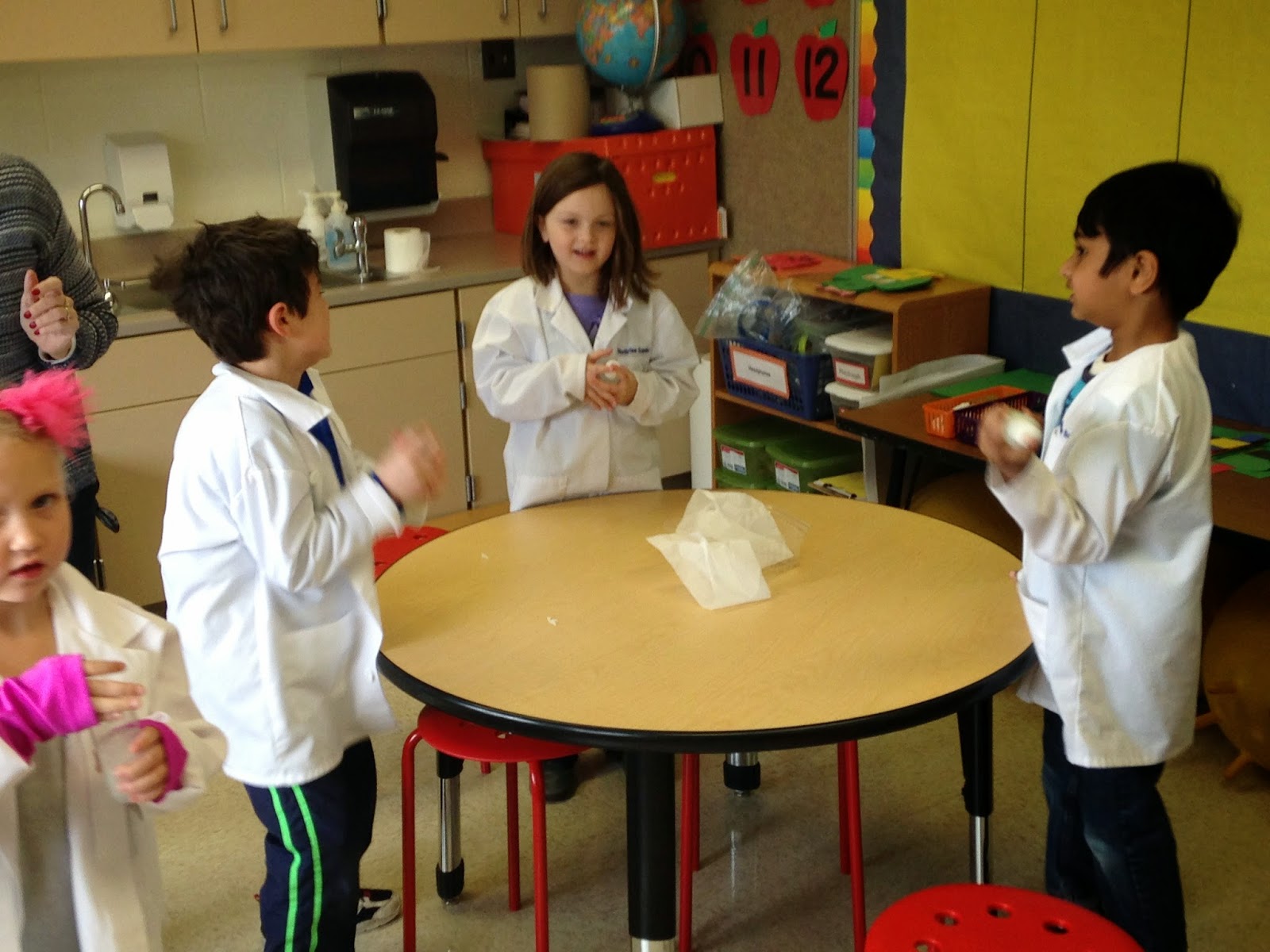
One of the most fun science investigations we do all year in Kindergarten is Recycling Paper.  It takes a lot of hard work and listening to do this investigation correctly.  Luckily, there are great scientists in this class and they did an amazing job of listening and following directions!

We began by taking some single ply toilet tissue and tearing it into tiny pieces.  We placed the pieces in a small plastic bottle.  Next we added some water to the bottle and placed the lid on tightly.  Then we shook the bottles for about five minutes.  That was hard work!


This part of the investigation helped us create paper pulp, which is the name of the substance we now had in our bottles after shaking them.  We placed a screen on top of a plastic cup and emptied the contents of the jar onto the screen.  The excess water drained in to the cup below.


Next we placed a second screen on top of the paper pulp, squeezed the screens together and used a sponge to blot off the excess water.  The sponges worked great because they absorb water!


Our next step was to remove the screens and pulp from the top of the cups and place them on some newspaper.  We learned on Tuesday that newsprint floats so we thought it would be absorbent.  It was! We blotted the screens and the pulp as hard as we could to get all the extra water out of it!


 We took the top screen off and used our plastic bottle as a rolling pin to smooth out the recycled paper and squeeze out any last bits of water.  Finally, we carefully peeled the recycled paper off of the screen and placed it on wax paper to dry over night.


We really loved doing this investigation.  After spring break, we will be learning about fabric!


Paper and Water

On Tuesday, we shifted our focus from wood to paper.  Our investigation was called Paper and Water.  Our goal was to see what happens when you put paper and water together.  We got our lab coats, arranged ourselves in our research teams and set out to work.  

We started by gathering the tools we would need…water, eye droppers and paper samples.  First we explored the five paper samples.  These included paper towel, newsprint, wax paper, chipboard and cardboard.  


Next, using the eyedroppers, we added drops of water to each paper sample and observed what happened.


We discovered that some of the paper samples absorbed the water and some of them repelled the water.  Interesting!  Then we wondered what would happen if we placed each one of the paper samples in a basin of water.  Would they sink or float?  We had to find out!


Ms. Kieltyka chose scientists to place a sample of each type of paper in the basin.


 Once all the samples were placed in the basin, we watched.  The paper towel sank right away…but none of the others did.  We decided to keep an eye on it throughout the day.  By the time we went home on Tuesday, the chipboard had also sunk.  We decided to leave it overnight and check on it in the morning.

You'll never believe this…when we arrived Wednesday morning, the cardboard, newsprint and wax paper sample were all still floating!  We left them for another 24 hours and the three remaining samples were still floating.  We were surprised at our discoveries with this investigation!


Making Plywood

On Monday, our Science investigation had us discovering how plywood is made.  Plywood is a manmade wood, made by gluing thin layers of wood together.  To demonstrate this process, we glued wooden craft sticks together.  By doing this, we learned how much stronger the plywood was.  One single layer was quite easy for us to break.  However, when we glued several layers together, the plywood became much stronger and we were unable to break it.


During Writer's Workshop, we reported on the process of making plywood.  We shared our writing with our classmates.